Education5 min read
Discrete Math: Study & Quiz Guide — How to Work Through Each Unit
How to use Discrete Math: Study & Quiz unit by unit: what its ten units cover, which practice mode suits which job, and when to reach for the logic tools.
Study discrete mathematics unit by unit — logic, proofs, sets, counting, probability and graphs — and quiz what you know.
Free to download · Published by Reign Creative LLC
About this app
Discrete Math: Study & Quiz is a study companion for the course that most computer science and mathematics students meet early: logic, proofs, sets, functions and relations, counting, probability and graphs. The listing is written for college students, computer science learners and anyone returning to the subject, and its approach is to learn the idea behind a symbol before practising with it.
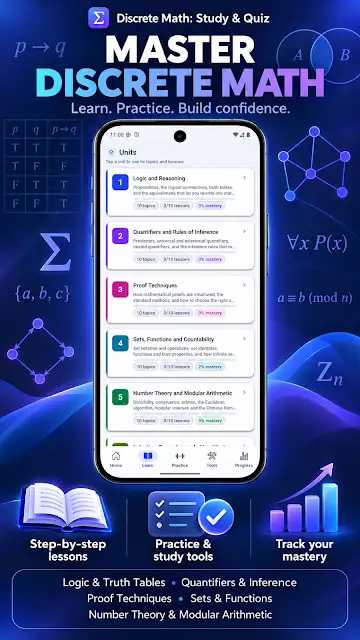
The store screenshots show the course as a sequence of units — logic and reasoning; quantifiers and rules of inference; proof techniques; sets, functions and countability; number theory and modular arithmetic; induction and algorithms; combinatorics; probability; recurrences; and graph theory — each broken into topics and lessons with knowledge checks and a mastery measure.
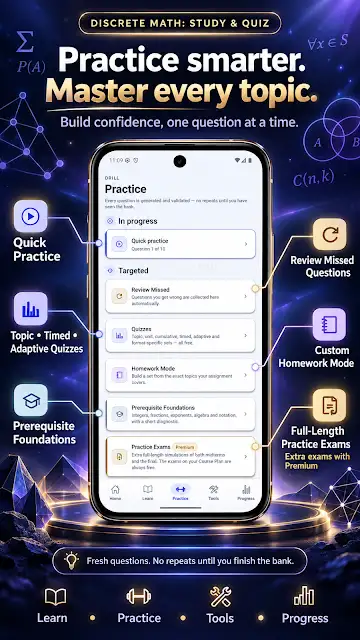
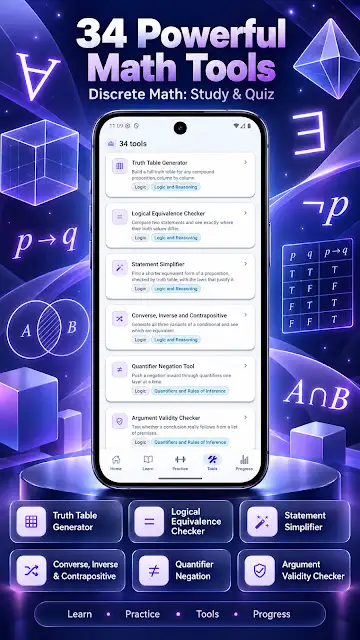
Practice comes in several forms: quick practice, topic, timed and adaptive quizzes, review of missed questions, a custom homework mode and full-length practice exams. A tools section includes a truth-table generator, a logical-equivalence checker, a statement simplifier, a converse-inverse-contrapositive helper, quantifier negation and an argument-validity checker, and a progress screen tracks accuracy, streaks, weekly goals and focus time.
Store details checked against the live Google Play listing on . Google Play is the source of truth.
Images from the app’s own store listing, which describe it in the developer’s words.
Key features
From logic and proof techniques through combinatorics, probability, recurrences and graph theory.
Quick practice, topic, timed and adaptive quizzes, review of missed questions and full-length exams.
Truth-table generator, logical-equivalence checker, statement simplifier and argument-validity checker.
Build a set of questions around what you are studying this week.
Mastery by unit, accuracy, streaks, weekly study goals and a focus timer.
Start with a familiar idea and work toward the topics that challenge you.
Read the lesson and check understanding before you practise.
Use quizzes and tools, then review what you got wrong.
Follow progress by unit and set weekly goals as an exam approaches.
Good to know
Have a different question? Contact our support team.
Published by Reign Creative LLC, which makes Discrete Math: Study & Quiz. 66 in total — the topic hubs below collect them all.
How to use Discrete Math: Study & Quiz unit by unit: what its ten units cover, which practice mode suits which job, and when to reach for the logic tools.
How to store a graph as an adjacency matrix, an adjacency list or an edge list, what each costs, and how matrix powers count walks and triangles.
What f(n) = O(g(n)) means, how to prove it by finding constants c and k, how big-Omega and big-Theta differ, and the growth classes that algorithms fall into.
When a fixed number of independent trials each succeed with the same chance, the count of successes is binomial. Formula, mean, variance and examples.
Why the coefficients of (x + y)ⁿ are the numbers n choose k, how Pascal's triangle builds them, a worked expansion, and identities you can prove by counting.
A graph is bipartite when its vertices split into two sides with every edge crossing between. How to test it, why odd cycles rule it out, and matchings.
Reign Creative LLC is open to serious discussions about Discrete Math: Study & Quiz — publishing, licensing, co-development or an acquisition. Read Discrete Math: Study & Quiz for Universities, Tutors and Edtech Partners or see every partnership opportunity.
Study discrete mathematics unit by unit — logic, proofs, sets, counting, probability and graphs — and quiz what you know. Free on Google Play.