Key takeaways
- They are separate games, not two difficulty settings on one game. The names are close enough to cause genuine confusion and the designs diverge on structure, ships, bosses, upgrades and store terms.
- Space Galaxy Attack Arcade is wave-based: one ship, four abilities — FIRE, ALT, Ultimate and Shield — and rewards spent on weapons, systems and bonuses, with an Endless Mode alongside the waves.
- Space Galaxy Attack Hardcore is campaign-shaped: multiple ships with their own loadouts, ten connected sectors, bosses built from destructible modules, an eight-axis upgrade tree and three named difficulty modes.
- The clearest single split is boss design. Arcade bosses reward learning an attack pattern and finding the opening; Hardcore bosses additionally reward knowing which part of the boss to shoot.
- Store terms differ: both are free and ad-supported and rated Everyone, but the Arcade listing declares in-app purchases and the Hardcore listing does not.
- If you have never played a shoot 'em up, the wave-based one is the gentler entry; if you want a difficulty ceiling and a campaign you can put down mid-sector, the other is built for that.
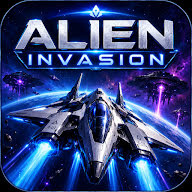
Space Galaxy Attack Arcade and Space Galaxy Attack Hardcore are two different games. They come from the same studio — both are ours, built by Reign Creative — they share a naming convention, and they are frequently mistaken for one product with a difficulty toggle. They are not. The differences run through structure, ship selection, boss design, the upgrade system and the store terms.
This is a comparison rather than a recommendation, and the honest answer to "which one" depends on something only you know: whether you want short repeatable runs or a campaign you can work through over weeks.
The two designs at a glance
The table below sets out the differences that are visible in each game's own description and verified store listing. Everything in it is a published fact about the current versions rather than an impression from play.
| Space Galaxy Attack Arcade | Space Galaxy Attack Hardcore | |
|---|---|---|
| Shape | Wave-based arcade combat | Connected campaign of ten sectors |
| Ships | One ship, four abilities | Multiple ships, each with its own loadout |
| Abilities | FIRE, ALT, Ultimate, Shield | Primary weapon, alternate attack, shield, ultimate, varying by ship |
| Bosses | Heavy attacks with openings to find | Minibosses and multi-phase bosses with destructible modules |
| Difficulty | Escalating waves, plus Endless Mode | Normal, Hardcore and Endless as named modes |
| Upgrades | Weapons, unlocked upgrades, ship systems and chosen bonuses | Damage, firing speed, piercing, shields, hull durability, movement handling, cooldowns, ultimate charge |
| Interruptible | Run-based | Campaign can be paused, saved and continued |
| Art direction | Classic arcade space combat | Anime and manga-inspired |
| Store terms | Free, ad-supported, declares in-app purchases, rated Everyone | Free, ad-supported, no in-app purchases declared, rated Everyone |
Structure is the decision that matters most
Everything else follows from the first row of that table.
Space Galaxy Attack Arcade is organised around the run. Hostile fleets fill the screen, the safe route through them changes every few seconds, and the unit of play is an attempt that ends and is repeated. Rewards earned during a run go into the ship — stronger weapons, unlocked upgrades, improved systems and bonuses you pick yourself — so the loop is: run, die, get slightly stronger, run again. Endless Mode removes the finish line entirely for players who want to find out how far positioning and ability timing take them.
Space Galaxy Attack Hardcore is organised around a map. Its campaign runs from orbital stations and neon cities through asteroid fields and enemy factories to the Galactic Core, with each sector bringing its own enemy movement and attack patterns. Crucially, it can be paused, saved and continued, so a sector left half-finished on a commute is still half-finished later. That single feature changes what kind of game it is: a run-based shooter asks for five minutes, a saved campaign asks for a commitment it then respects.
If you are choosing on this axis alone, ask what happens when you are interrupted. If being interrupted means losing nothing, the run-based design suits you. If being interrupted means losing a position you were building towards, the save matters.
Ship choice, and what it does to the learning curve
The arcade title gives you one ship and four clearly labelled controls: FIRE for main weapons, ALT for a secondary attack, an Ultimate that charges for the moments that need it, and a Shield that buys an exit when the screen closes in. The design intent is legible — every wave is effectively a question about which of the four to spend — and there is nothing to configure before you can start learning.
Hardcore instead asks you to pick a spacecraft, along with the primary weapon, alternate attack, shield and ultimate that suit how you like to fly. That is more expressive and it is also a decision made before you have the information to make it well. The upgrade tree extends the same trade: damage, firing speed, piercing, shields, hull durability, movement handling, cooldowns and ultimate charge are eight separate purchases rather than one pool, which rewards a player who knows what killed them and punishes one who does not.
Research on difficulty in games is built on the premise that engagement depends on matching challenge to a player's current skill — keeping a player challenged without being overwhelmed is the stated goal of the whole dynamic-difficulty-adjustment literature. Applied here, the practical reading is that more configuration is not automatically more accessible. A single ship with four buttons is a narrower experience and a shallower first hour of confusion.
Boss design is the real dividing line
This is where the two games diverge in the way that actually changes how you play, and it is the difference most easily missed from a store page.
Arcade bosses are pattern problems. They bring heavy attacks with openings you have to find, and the skill being tested is reading a telegraph and putting your ship somewhere survivable. We wrote about that skill in general in reading enemy fire and getting good at a space shooter.
Hardcore bosses add a second problem on top of the first. Minibosses and multi-phase galaxy bosses carry destructible modules, and the game's own framing is that learning where to aim matters more than raw firepower. A player who has mastered dodging can still fail these fights indefinitely by putting damage into the wrong part of the target — which is a genuinely different failure mode, and one no amount of upgrading fixes.
That difference has a knock-on effect on how the two games reward practice. Research on practice schedules in motor learning finds that repeating a fixed task produces good performance within a session and weaker retention later, while varied practice does the reverse. A pattern-recognition boss suits blocked repetition reasonably well, because the sequence is fixed. A module-priority boss has a decision embedded in it, and decisions transfer differently from sequences. What each difficulty tier actually changes, in either game, is set out in shmup difficulty tiers.
Difficulty as something you choose, or something you meet
Hardcore names its tiers. Normal is classic arcade progression; Hardcore raises enemy durability, projectile speed and formation complexity and gives bosses extra attack patterns with fewer openings; Endless drops the campaign and keeps sending waves. The top tier is explicitly built for players who already know the fights.
Arcade does not present named tiers. Difficulty arrives through the waves themselves, with early waves approachable and pressure building as you go.
Which of those is preferable is a question about the experience you want rather than about quality. Research examining how players of deliberately punishing games write about them found that difficulty framed with clarity and fairness gets reinterpreted by long-term players as a form of absorption rather than as frustration — failure read as instruction rather than as punishment. That reframing is available to some players and not to others, and it is not a character flaw either way. A named Hardcore tier is an invitation to that relationship with a game. A wave curve with no label is not asking for it.
A short decision guide
If you have never played a vertical shooter, start with the wave-based one. Four labelled abilities and a single ship is the smallest amount of apparatus between you and the genre, and the general question of picking a vertical shooter worth learning is covered in vertical shooters on Android.
If you want a campaign with a map, a save, and bosses that ask a targeting question as well as a dodging one, the Hardcore title is the one designed for that, and it is also the one whose store listing declares no in-app purchases.
If you want both, they do not overlap as much as the names imply, and playing them alternately is a reasonable use of the varied-practice effect described above.
Full feature lists are on each app's page — Space Galaxy Attack Hardcore and Space Galaxy Attack Arcade — and the rest of our writing on the genre sits under action and arcade games.
Good to know
Frequently asked questions
Are Space Galaxy Attack Arcade and Space Galaxy Attack Hardcore the same game?
Which one has an actual campaign?
Which one is harder?
Do either of them charge money?
Sources
- Exploring Dynamic Difficulty Adjustment in Videogames (opens in a new tab)arXiv (preprint) — accessed
- High contextual interference improves retention in motor learning: systematic review and meta-analysis (opens in a new tab)Scientific Reports (via PubMed Central) — accessed
- Struggle as Flow: Challenge, Design, and Experience in Soulslike Games (opens in a new tab)arXiv (preprint) — accessed
About the author
Reign Creative LLC — The independent app studio that builds the apps covered on this site and publishes every article here. On Google Play it publishes as Reign Collective Apps.
We use AI tools to help research, draft and edit our articles. Each article lists the sources its factual claims rely on, and details about our apps come from their live Google Play listings. No article on this site has been reviewed by an independent expert unless the reviewer is named on it.
Spotted an error? Tell us — how corrections are handled is set out in our editorial policy.